📱 Smart QR Code
Scan to view & share this memorial biography directly.
🌹 Prayers
Click to send your sincere respect and prayers for this hero
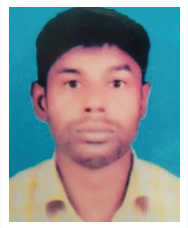
Md. Lebu Sheikh
📅 Date of Birth
28 July, 1984
🕊️ Date of Martyrdom
5 August, 2024
🗺️ Division
Dhaka_City
📍 District
Sirajganj
👤 Short Biography
Profession: Garment Worker
Place of Martyrdom: Ashulia, Savar
Incident Details & Martyrdom Narrative
A Life Stopped in Its Tracks"**
Birth and Upbringing
Md. Lebu Sheikh was born on 28 July 1984 in the small village of Dumrai in Raiganj Upazila, Sirajganj district. His childhood began in a modest tin-roofed house on the edge of the village, where an unpaved dirt road ran by.
His father, Joratulla Sheikh, was a humble farmer, and his mother, Najma Begum Sabura, a devoted homemaker. Lebu was the second among six siblings, but he bore the family’s responsibilities as if the eldest.
While young Lebu’s small hands dug into the earth of their home yard for play, life was already pulling him into harsh lessons. Daily shortages, the mother’s tearful eyes over rice and food scarcity, and the weariness etched on his father’s face forced little Lebu to grow up faster than time intended.
When struggling to meet basic needs was a daily reality, school books and notebooks seemed like luxuries far beyond reach. Instead of crossing the school threshold, Lebu entered the world of work — learning how to carry goods, keep accounts, and wear a faint smile while pretending to be satisfied with less food than needed.
Some might call him “deprived,†but the truth is Lebu was a fighter — one who embraced life quietly but unwaveringly. His growth was marked by dusty country paths and sweat-soaked clothes.
Work Life and Dreams
He worked as a shop assistant in the village market, where he learned the art of conversation, laughter, and earning trust. His days were spent laboring; his nights, weaving dreams.
Dreams of owning a home, providing a good bed for his mother, and creating peace for his family.
His childhood and adolescence were not blessed with childhood luxuries or glimpses of light, but he never surrendered. Amid poverty, deprivation, and loneliness, he built a character full of honesty, hard work, and dignity.
His life was a silent struggle unfolding every day in the neglected corners of society, out of sight.
Career and Aspirations
For one who grew up in poverty, dreaming was difficult, and fulfilling those dreams, an immense challenge. Md. Lebu Sheikh was one such struggler who passed through life’s stages with bowed head never, wiping the sweat of labor with pride. As a teenager, he left school behind and took up the burden of labor. He gained experience working in people’s shops before entering the garment industry in Dhaka, joining the vast ranks of laborers. Among hundreds of workers, Lebu was a silent worker who day after day left his mark on every stitch under the clatter of sewing machines. Garment factory life was not easy — long hours standing, pressure to meet targets, and the pain of unfair wages. Yet Lebu never gave up. He knew every drop of sweat was an installment toward a dream: one day owning a house with peace, safety, and love. On this path, he bought a low-lying plot of land near his village, pooling resources with his elder brother. But he did not stop at just buying land — he filled it with nearly 400 truckloads of soil. In his imagination, he could see his mother sitting in the courtyard, his wife lovingly watering plants. He pictured the sun’s rays shimmering on the door after prayer, reflecting a peaceful life. His plan was to start building in early 2025 — a tin-roofed structure with cement floors. But his dream was stronger than concrete because it was built on the earnings of his own labor. Yet fate’s cruelty does not always allow dreams to be fulfilled. Many dreams fall like dust through closed eyes. Lebu’s dream fell too, in a flood of blood. That land still lies fallow — without a home, without a dream. Only the wind knows how much pain it takes to stand there, waiting for a martyr.
Family Life
Along his difficult life’s journey, Lebu found a life partner — Selina Akter.
Though they had no children, their home was neat, filled with affection and mutual trust.
Not a wealthy family, not a luxurious life, but spiritual peace and silent bonds of respect and love. Selina’s life had not been easy either. She lost her mother at just three months old, and her father’s love was short-lived. After her father remarried, she was sent to live with her aunt. There, Selina grew up in her aunt’s care — a refuge that was her only shelter. But that refuge ended when her aunt passed away. When she came of marriageable age, relatives decided to marry her off to provide her a place in life. That refuge came in the form of Lebu Sheikh. An honest, hardworking, and sensitive man who respected Selina as not only a wife but as a human being. Selina herself felt that after so much hardship, Lebu was like a quiet light in her life.
Their Married Life
Their home was small but full of peace. Lebu was a devout Muslim, faithful in his five daily prayers, quiet in speech, simple in demeanor. Worldly greed and desire never found a place in his life. He believed true success was working honestly and building one’s own home.
Selina said,
"Lebu was a very good person.
He wanted to walk the path of Allah.
He was not involved in politics.
He led a simple life."
Within that simplicity was extraordinary love, devotion, and mutual respect. Though childless, there was no bitterness or lack in their marriage. Each day was a new hope, a new step toward building their shared dream. Lebu had silently promised himself never to hurt Selina. With his limited income, he aimed to bring a smile to her face every day. Going to the market together, buying new clothes for Eid, holding hands while dreaming of the future — these were their happiness. Now that home is lonely. Selina faces a second great void, heavier and more permanent. Holding her husband’s photo, she perhaps still thinks if only they had more time — they could have built that dream home together.
Joining the July Revolution and Movement
July 2024 marked a new chapter in Bangladesh’s history — known today as the "July Revolution."
It was not merely a political agenda but a heartfelt outcry from oppressed, neglected, and discriminated students and common people. From cities to villages, garment workers to university students, rickshaw pullers to doctors — all spoke in one voice: "This discrimination must end!" This movement was an explosion of long-suppressed sighs, collective grievances, and rebellion. At its core was a demand for rightful justice, human dignity, and a clear protest against state discrimination. From the streets of Dhaka, the waves of protest spread to Chittagong, Rajshahi, Khulna, Barisal, Sylhet, Rangpur, and even the remotest village crossroads. This was a movement of laborers too. Garment workers, day laborers, the hardworking poor who sweat daily for bread but whose voices rarely reached state ears — they had an important place in this revolution. Md. Lebu Sheikh was one such laborer’s representative. Not a politician, not under any party banner, he responded only to the call of his heart. His sole purpose: to dream of change. A Bangladesh where the sweat of a worker is not ignored. Where a common man can build a roof over his family’s head.
The March to Dhaka, 5 August 2024
The "March to Dhaka" program announced on 5 August 2024 was a central call of the movement. Lebu Sheikh was among thousands joining the march toward Dhaka. Near Ashulia Police Station in Savar, the procession gathered. In his eyes shone determination, in his heart, a dream of a free society. He was no political activist, no public speaker. Yet his bond to the movement was deep and sincere. Because it was for people like him — for their dreams. That day, he had no fear, no doubt. He believed the power of the movement would one day build a just society.
The Martyrdom
But before that dream could be realized, his journey was cut short. On 5 August 2024, a day forever marked in Bangladesh’s history as bloody and tragic, the sun rose under a troubled sky. Tension and unrest filled the air. People hurried from all corners to join the "March to Dhaka," hearts filled with hope of reclaiming rights, voices filled with determination. Lebu Sheikh was a silent soldier among the crowd. He carried no party banners, no anger on his face. Only faith that this path would change the fate of countless common people. He was in Ashulia, a key location of the protests. The road was long and dusty, yet hope burned bright. But to the state, this was a crime. By noon, police suddenly opened fire on protesters. The streets instantly turned into scenes of carnage. People ran, screams tore the sky. Amidst the chaos, Lebu Sheikh was shot in the abdomen. Bleeding and helpless, there was no ambulance. No opportunity for treatment. The ease with which the life of a poor man was extinguished became a harsh statement from the state. Within moments, it was clear — Lebu was gone.
News spread from Savar to Dumrai village in Raiganj.
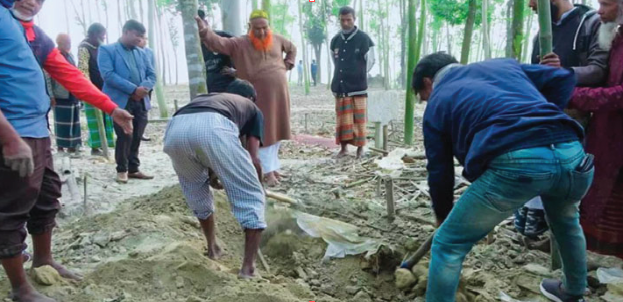
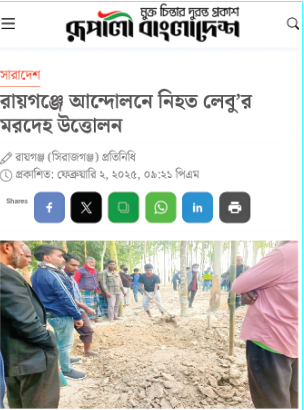
His wife Selina, mother Najma Begum, elder brother Fazal Hossain, and beloved nephew Hasan — whom Lebu had raised as his own son — broke down in inconsolable grief. No government assistance was provided for bringing the body home. The family rented a pickup at their own expense to bring his lifeless body to the village. No state representative, no accountability anywhere. On 6 August 2024, after funeral prayers in the village cemetery, Shahid Lebu Sheikh was laid to rest. No postmortem. No investigation. No justice pursued. Only a sorrowful burial where the earth covered a poor man’s dreams, hopes of building a home, a loving family, and desire to live. His death was not just an incident — it was a naked revelation of the state’s injustice, a bloody fall of a brave voice standing against discrimination.
Voices of Close Relatives
Fazal Hossain, elder brother, said:
"The pain of losing a brother cannot be explained.
Even without his own children, he was raising my son like his own."
Hasan, his nephew, said:
"I used to call him ‘Abbu’ (father) and uncle ‘Amma’ (mother).
On the day of the incident, uncle kept calling me, but I was asleep.
Later I found out he had become a martyr."
Selina said:
"Allah did not grant me happiness in this life, so He took my husband too soon.
Now, my only wish is that he resides in Jannah (Paradise)."
She added,
"Those who died in the movement must receive state recognition."
Najma Begum, his mother, crying said:
"I could not give my son anything.
They killed him with bullets.
They emptied my chest.
I want justice."
Post-Martyrdom Life and Assistance
After his martyrdom, Selina returned to her father’s home in Jamalpur. Every day passes in uncertainty and sorrow. The family demands a job for Selina, hoping she can then somewhat sustain her life. No permanent government assistance has been received, although some organizations and political parties have stepped forward. The July Martyr Memorial Foundation provided 500,000 BDT, and Jamaat-e-Islami gave 200,000 BDT. Selina and her mother-in-law divided the money. Before Eid, they received some supplies from the Deputy Commissioner, UNO, and BNP representatives. At Ashulia Police Station, a case has been filed naming 15 accused and 300-400 unidentified persons.
At a Glance: Shahid Profile
Full Name Md. Lebu Sheikh
Date of Birth 28 July 1984
Occupation Garment Worker
Father Joratulla Sheikh (deceased)
Mother Najma Begum (housewife)
Wife Selina Akter, age 22, housewife
Permanent Address Dumrai, Raiganj, Sirajganj
Religion Devout Muslim, regular in five daily prayers
Family Wife Selina Akter, childless
Movement Participation "March to Dhaka," 5 August 2024
Place of Martyrdom Ashulia, Savar
Burial Date 6 August 2024, in home village
Assistance Received July Martyr Memorial Foundation, Jamaat-e-Islami, some local help
Family Demands State recognition as martyr, job for Selina, ensure justice
Economic Proposals
1. Provide Selina Akter, wife of Lebu Sheikh, with a government job or monthly allowance for rehabilitation.
2. Arrange government grants for house construction in the family’s name to ensure financial stability.
3. Establish a special welfare fund to provide permanent support for Shahid Lebu Sheikh’s family.
4. Expedite state compensation and recognition for all July martyrs, including Lebu Sheikh.
Quranic Verse
They rejoice in what Allah has bestowed upon them of His bounty, and they rejoice for those who have not yet joined them. (Surah Al-Imran 3:170)
Hadith Sharif
The Messenger of Allah (SAW) said, "A martyr will be able to intercede for seventy relatives in Paradise." (Sunan Abu Dawood 2520)
👥 Shaheeds from the Same Division
Dhaka_City


Memorial Photo Gallery