📱 Smart QR Code
Scan to view & share this memorial biography directly.
🌹 Prayers
Click to send your sincere respect and prayers for this hero
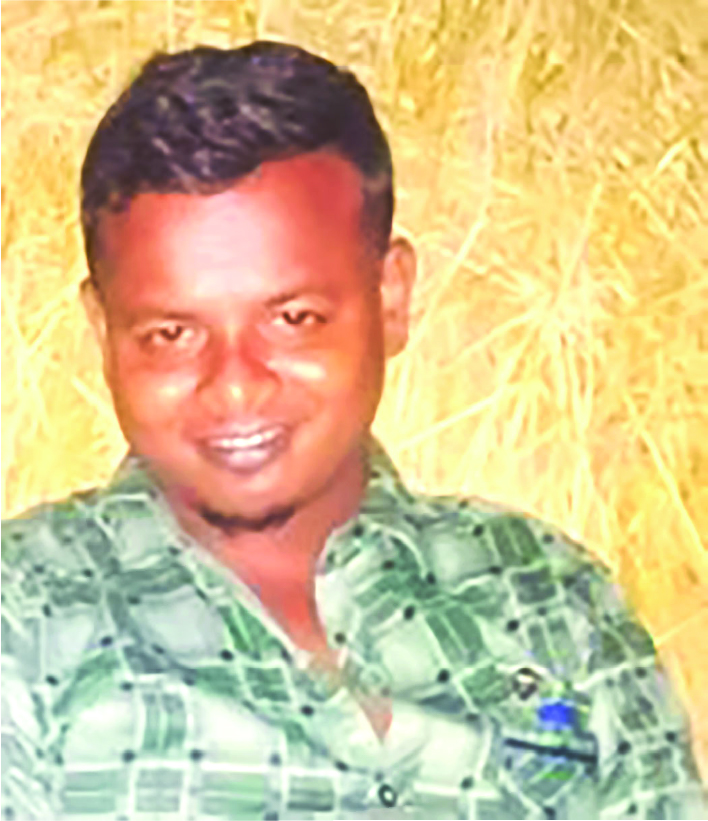
Jahangir Alam
📅 Date of Birth
1 January, 1990
🕊️ Date of Martyrdom
4 August, 2024
🗺️ Division
Dhaka
📍 District
Narsingdi
👤 Short Biography
Profession: Rickshaw Puller.
Place of Martyrdom: Shaheed Suhrawardy Hospital.
Incident Details & Martyrdom Narrative
Grassroots Citizen Jahangir Alam
Shaheed Jahangir Alam is one of the representatives of the country's lower-income class. He tries to support his poor family with whatever he earns by pulling passengers all day long with a rented rickshaw. Some days he gets good fares, some days he doesn't. In the face of uncontrolled inflation, his entire day's earnings are exhausted just by buying rice, lentils, and salt for the family. He has to work tirelessly to meet the minimum needs of his family. His greatest dream in life seems to be eating a little better, wearing good clothes, and living in a good place. He has to struggle constantly with life to fulfill this little dream.
In a society where low-income people like rickshaw puller Jahangir Alam visit 10 shops to buy fish for one meal, bargain repeatedly with shopkeepers, and often have to leave their favorite small fish in the market because they can't afford it, the dream of good food, good clothes, good housing, and educating children in a good school seems quite incongruous. But when they are a husband, a father, an elder brother, or one of the guardians of the family, can they neglect their responsibilities? No, they can't. That's why they rely on the Almighty and continue to struggle for their families and to fulfill their dreams by sacrificing everything they have. They work tirelessly throughout their lives, shedding sweat and blood. In this battle of life, they sometimes get injured or sick. But they never give up. Shaheed Jahangir Alam himself did not give up. Until the last day of his life, he sacrificed his life for his family, for the country, for the people of the country, for the just rights of the people, and to eliminate all discrimination in society, state, and nation.
Why the Rickshaw Puller Joined the Movement
Mr. Jahangir Alam, a simple rickshaw puller from the village. Everyone loved this ever-smiling, simple-minded person who hid his hunger and inner pain, solely for his simplicity and honesty. Even many young and old people in the area used to tease and joke with Shaheed Jahangir Alam. The generous-minded Jahangir also gave them his love wholeheartedly. He tried to forget the sorrows of life's deprivations. He also wanted to make others forget their sorrows. That's why he never got angry with anyone. And why would he be angry? He was a rickshaw puller. A direct and indirect witness to the daily joys and sorrows of the common people. A witness to various incidents and accidents on roads, markets, alleys, and, in a word, inside and outside homes. Therefore, he understood the pulse of the common people; their joys and sorrows, happiness and pain. July 2024.
General university students called for an anti-discrimination student movement. They were conducting various peaceful rallies, processions, meetings, and shows on various university campuses and streets. On July 16, the autocratic government fired on the peaceful student movement. At least six students, including Abu Saeed, a student of Rokeya University in Rangpur, were Martyred across the country. Hundreds of students were injured. Wow! The thick-headed Awami government made the mistake of poking a hornet's nest. Not once or twice, but repeatedly.
All the university students across the country were enraged after being shot. School, college, and madrasa students also joined them. They would not return home without fulfilling their demands. Four years ago, in 2018, during the safe road movement, young school and college children had responsibly taken charge of traffic. They had even stopped police and RAB vehicles for not having proper vehicle documents and driving licenses! They had given the autocratic Hasina's administration a tough time. Four years later, they were now more mature. They had formed an anti-discrimination student movement with their seniors. As the nationwide student movement became more and more intense, the killer Hasina's police, RAB, BGB, SWAT, and Ansar forces were engaged in a bloody game with the students.
After July 16, the streets, university campuses, university halls, hostels, and homes were stained with the blood of students every day. On July 18, the killer Hasina massacred the students, imposed a curfew, and shut down the internet. Then, secret massacres, mass graves, and mass arrests like the black night of March 25 were carried out in various places in the dark of night. On one hand, ordinary people were confined to their homes due to the curfew, and on the other hand, the internet was shut down, so the socially isolated people could not know anything about the secret misdeeds of the autocratic government. When the curfew was lifted, students took to the streets again in large numbers. The killer Hasina's massacre started again. At the instigation of the world's betrayer Hasina, a drama of accepting demands in court was staged.
Finally, under the angry wrath of the people and international pressure, the Awami government turned on the internet. Then, along with the people of Bangladesh, the whole world witnessed how students were massacred by imposing a curfew and shutting down the internet. Those pictures and videos reached people's hands through social media. The common people could no longer sit at home. They came down to the streets in a flood. This time, teachers, professionals, intellectuals, journalists, lawyers, porters, laborers, and the general public of Bengal joined the students. A one-point movement to overthrow the government began. Autocratic killer Hasina did not leave any weapon of the state machinery unused against the protesters.
Except for some of their own sinners stamped by the autocrat, Hasina's bloodthirsty administration and their characterless, lewd, goon henchmen Chhatra League, Jubo League, and Awami League shot, beat, and hacked to death anyone they found in any condition. Shahbagh atheists and Olama League members were also deployed against the students and the public. Ordinary people were shot like rain from helicopters. Even small children playing inside their homes were not spared. Minor children fell in front of their dolls after being shot by killer Hasina. In such a dire situation in the country, the heart of Jahangir Alam, a very ordinary citizen and rickshaw puller, was stirred. Thousands of questions arose in his mind.
Is this city of corpses; this death-filled, terrifying country; this state of distrust and disbelief; this stage of revelry for protectors turned predators; these blood-soaked streets; this sky filled with the cries of the oppressed; this air filled with despair and curses. this continent of wrath his beloved homeland? His Bangladesh? How much longer will he have to endure such monstrous bites? How much longer will he have to give a share of his hard-earned money to the bribe-taking, corrupt traffic police? How much longer will he have to hand over his day's earnings to the snatchers and extortionists of Chhatra League and Jubo League on the streets and alleys? How many more days will his elderly parents suffer from lack of treatment due to lack of money? How many more days will his wife wear tattered clothes? How many more days will his children face empty plates of rice? How many more days will he have to face the embarrassing face of failure in front of his brothers and sisters? How many more days will this struggle to fulfill the basic needs of survival continue? How much longer? Simple Jahangir Alam's mind is filled with questions. But where are the answers? The answers come from the streets! The answers come from the student-public movement! The answers come from one death after another! The answers come from the Shaheed's procession! The answers come from the nationwide chaos of discrimination. On one hand, there is no food at home. On the other hand, you cannot go out on the street. If you go out, you will be shot! They kill people by shooting them like birds! They kill people by beating them like snakes! They kill people by hacking them like butchers! Either you have to starve to death by being trapped inside the house, or you have to go to the street and get shot. They left no way for ordinary people to survive. When this is the state of the country; when this is the reality of the lower and middle class, then the awakening of an ordinary rickshaw puller like Jahangir Alam is not absurd; not unrealistic, unimaginable, or illogical. It is the inevitable demand of the time; a logical reality. Then, Shaheed Jahangir Alam made a decision. He joined the anti-discrimination student movement, i.e., the July Revolution, to achieve the one-point demand for the overthrow of the government.
How he was injured
On August 4, 2024, at 11 am, Shaheed Jahangir Alam left home after bidding farewell to his birth mother, saying he was going to drive a rickshaw. Instead of driving a rickshaw, he joined the one-point movement to overthrow the government with his acquaintances. They were protesting in front of the municipality demanding the resignation of the autocratic government. It seemed as if the killer forces of the administration were tired of killing people. That's why, in front of the municipality that day, the innocent, unarmed students and the public were met with a sudden, brutal assault. Without warning, the police and other security forces launched a barrage of tear gas, rubber bullets, and live ammunition. The peaceful protest turned into a chaotic scene of violence.
Jahangir Alam, standing with his fellow protestors, was caught in the midst of the chaos. He witnessed the horrific violence firsthand – people being beaten, shot, and trampled. Despite the fear and confusion, he remained steadfast in his commitment to the cause.
Suddenly, a rubber bullet struck him in the leg. The impact was intense, causing him to stumble and fall. But he refused to give up. He tried to stand, to rejoin the protest, but the pain was too much. He was then hit by a tear gas canister, the chemical fumes burning his eyes and lungs.
Amidst the chaos, fellow protestors managed to pull him to safety. They carried him away from the front lines, seeking medical assistance. He was in severe pain, his leg swollen and bruised, his eyes stinging, and his breath ragged. The injuries he sustained were not just physical. They were a testament to the brutality of the regime, a stark reminder of the sacrifices made in the pursuit of justice.
The chaos continued around him, but he was removed from the immediate danger. Jahangir alam was carried to a makeshift medical station set up by the protestors.
Instead of driving his rickshaw, he joined the one-point movement to overthrow the government with his acquaintances. They were protesting in front of the municipality demanding the resignation of the autocratic government. It seemed as if the killer forces of the administration were tired of killing people. That's why, that day in front of the municipality, there was no sign of aggression from any force of the administration on the innocent, unarmed students and the public. The protesting students and the public were peacefully chanting slogans in support of their demands.
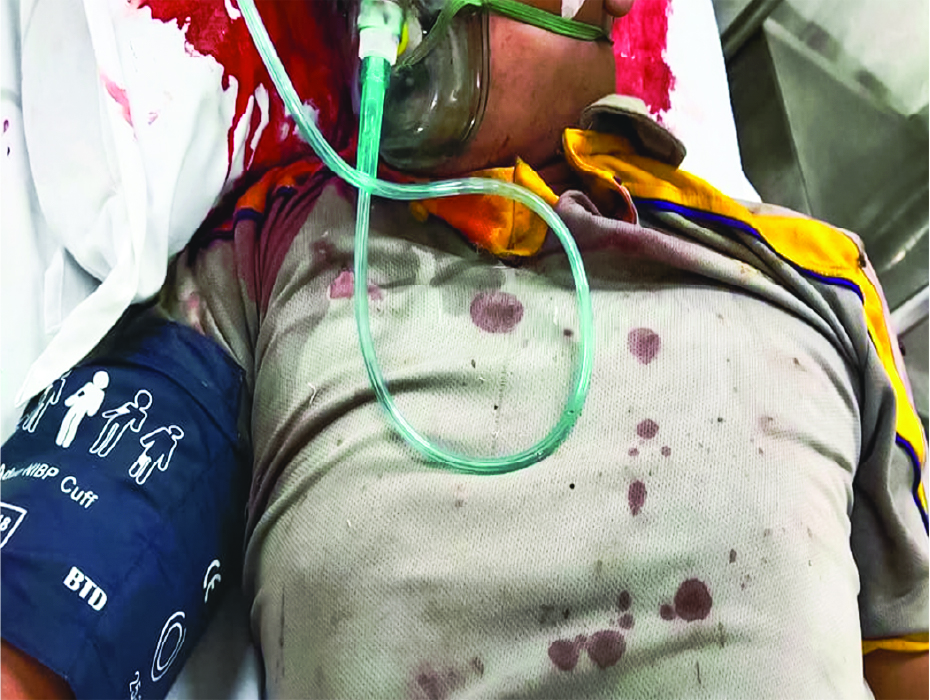
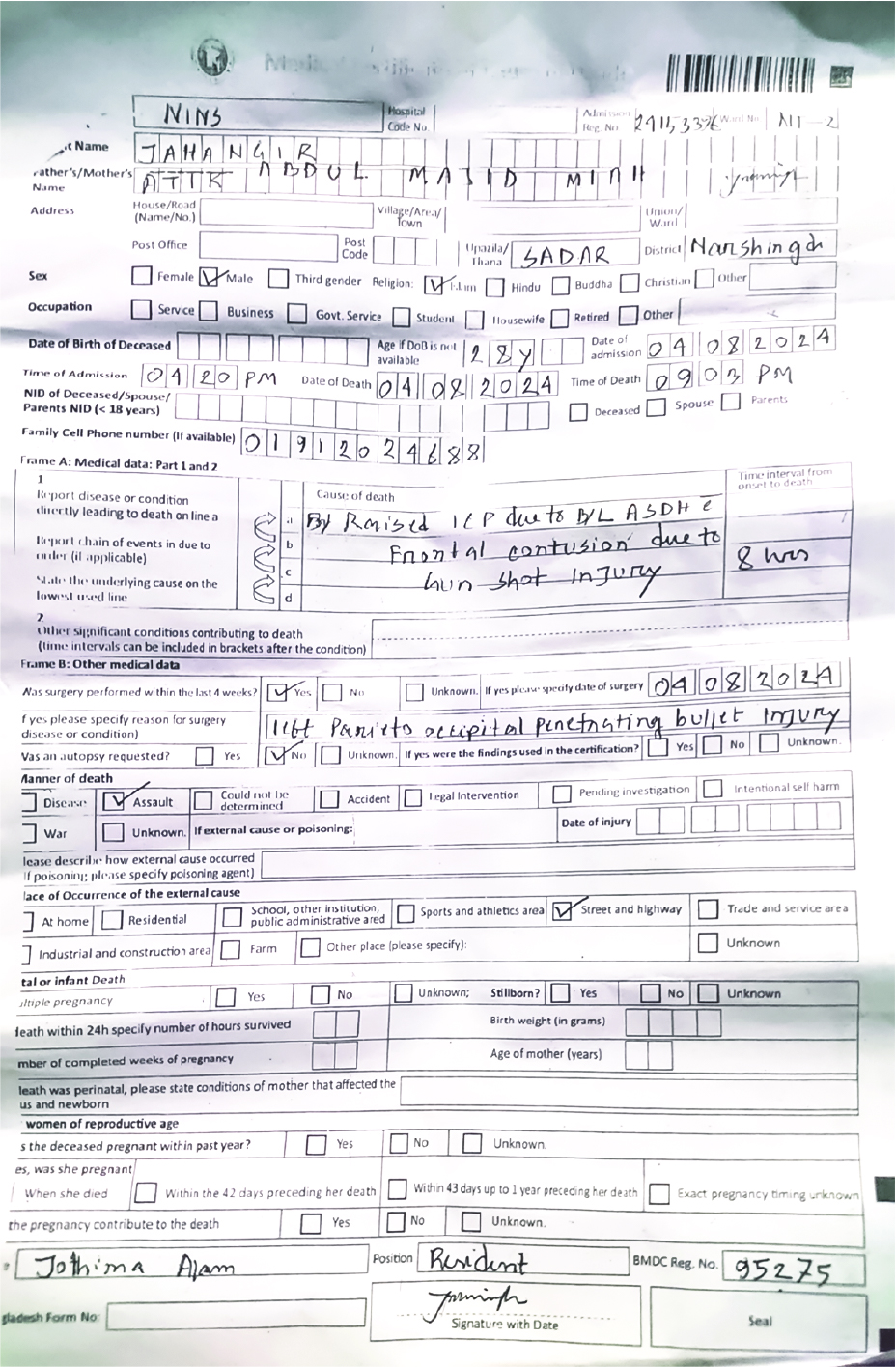
Around 12 noon, suddenly, the Awami terrorists, the dogs unleashed by the killer Hasina, came and fired indiscriminately at the protesters. In such a surprise attack, the students and the public were scattered. Several people fell to the ground after being shot. Everyone ran for safety. At that moment, a bullet from the killers entered Jahangir Alam's head from behind. He fell to the ground immediately. After the Awami goons fled after their gunfight, the students and the public rushed back to rescue the injured and the dead. Everyone was rescued and taken to the hospital.
How he became a Shaheed
The bullet-ridden Jahangir was lying on the side of the road. No one noticed him. After a while, someone's eyes were caught by the bullet-ridden Jahangir lying there. Immediately, he was also picked up by the protesters. Jahangir Alam, who was shot in the head, was taken to Dewan Hospital next to the municipality. A known person informed his family. Upon receiving the news, Jahangir Alam's younger brother, Md. Saidul, rushed to the hospital. After giving Jahangir Alam first aid at Dewan Hospital, his brother and the students and the public took him to Kurmitola Hospital on the advice of the doctor. From there, he was sent to Suhrawardy Hospital for better treatment. Here, while fighting against the poison of Hasina's sharp teeth, the bloodthirsty killer, Shaheed Jahangir Alam fell into the lap of cruel death at 9 pm. Another number was added to the list of oppressed Shaheeds. Another name was written in blood in the history of sacrifice and dedication - the hero of the July Revolution; Rickshaw puller Shaheed Jahangir Alam, the proof of the Awami autocrat's genocide to the world.
Recovery of the Shaheed's body
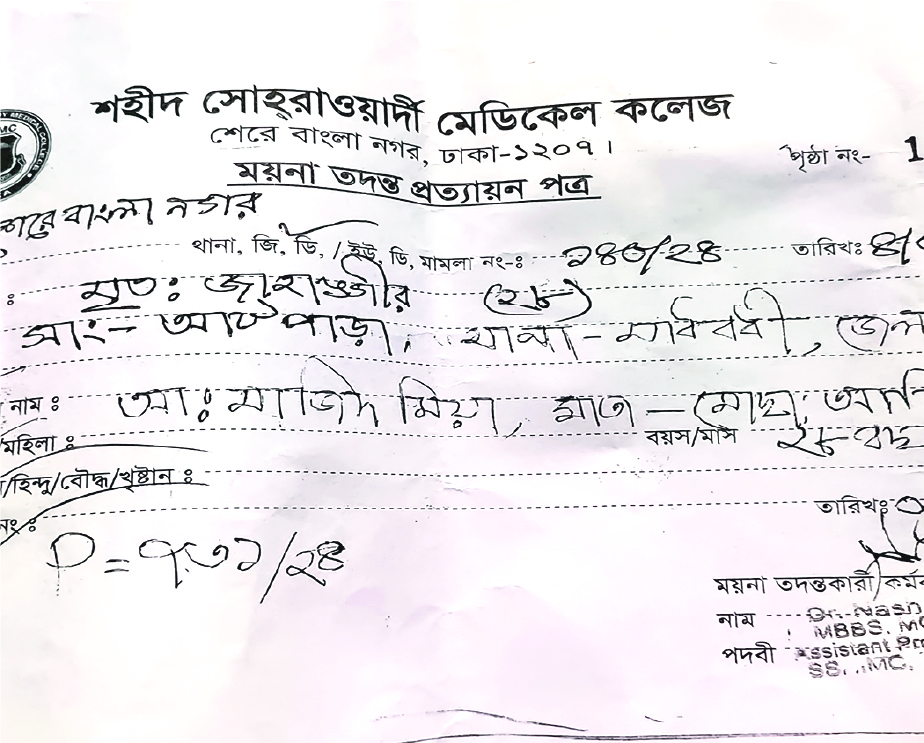
Although Shaheed Jahangir Alam died on August 4 while undergoing treatment at Suhrawardy Hospital, various excuses began to be made to hand over his body to his family. The body cannot be given without a postmortem; the postmortem cannot be done tonight; police clearance is required; there is a long queue of bodies for postmortem the next day; slow pace of doctors to do postmortem; overall bad situation in the country; such various excuses were made by the hospital. Finally, after killer Hasina fled like Lakshman Sen through the back door on August 5, the hospital was forced to hand over the body in the face of the anger of the students and the public and thousands of guardians. After the postmortem on August 5, the ambulance left for home with Jahangir Alam's body at 3 pm.
Shaheed's burial
The ambulance left the hospital with Jahangir Alam at 3 pm and reached his home in a very short time. As soon as the body was unloaded from the car, the sky and air were filled with the grief of the people present.
No one had the ability to bear the cries of his parents. The tears of his brothers and sisters, wife and children, and neighbors forced every eye present to shed tears. Finally, after the funeral in the presence of thousands of people in the Eidgah field of his village, Shaheed Jahangir Alam was buried in that Eidgah graveyard. Jahangir Alam, one of the representatives of the marginal people of the world, made his abode in the grave and left a beautiful world for the future generation; gave freedom; left the continuity of the revolution.
Comments of acquaintances
It is known from the friends, relatives, and neighbours of Shaheed Jahangir Alam that he was a very simple person. He never quarrelled with anyone. Although many young and old people joked with him, he never got angry.
Shaheed's Family Status
Shaheed Jahangir Alam left behind six members of his family before his death. His father, Majid Mia (55), is a marginal farmer. His mother, Afia (45), is a housewife. His only sister, Mansura (27), is a divorced housewife. She now lives in her father's house. His only brother, Mohammad Saidul (25), works as a laborer in a battery factory. His wife (26) is a housewife. His only daughter, Mosammat Mohana (6), studies in playgroup at Wisdom Primary School. The house of the Shaheed's father, Majid Mia, is made of tin. They have only 2% land in their own place. The livelihood is being run by the limited income of the younger brother. No other members of the family are involved in any earning-related work.
Proposal
In this situation, standing by the family left behind by Shaheed Jahangir Alam is the moral responsibility of all of us along with the government.
1. Arranging for the maintenance of the Shaheed's wife, children, and parents;
2. Taking care of the education expenses of the only daughter;
3. Arranging a business for the younger brother;
4. Arranging jobs for the Shaheed's widow and divorced sister, and considering their marriage in suitable places if they consent, can be considered as the demand of the time for this family.
Shaheed Jahangir Alam at a Glance
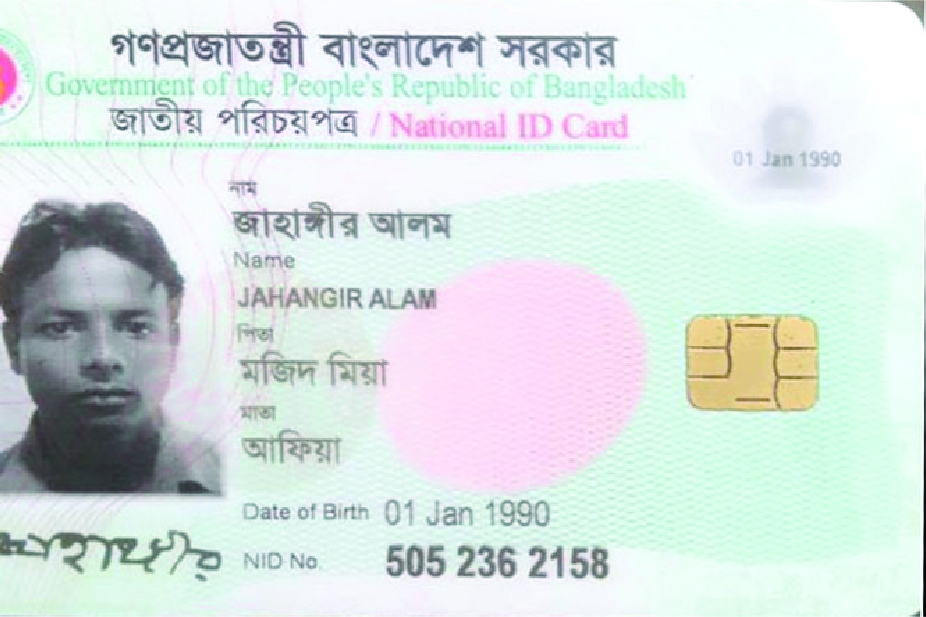
Name : Jahangir Alam
Birth : January 1, 1990
Death : August 4, 2024
Birthplace : Atpaika, Narsingdi
Father's Name : Majid Mia
Mother's Name : Afia
Current and Permanent
Address : Village: Atpaika, Ward No.: 7, Police Station: Madhabdi, District: Narsingdi
Professional Identity : Rickshaw Puller
Current Family Member
Count : 06
Joining the Movement : August 4, 2024, in front of Madhabdi Municipality
Time of Injury : August 4, 2024, 12 PM, in front of the municipality
Attacker : Awami League Terrorists
Day, Time, and Place of
Martyrdom : August 5, 2024, 9 PM, Shaheed Suhrawardy Hospital
Time and Place of
Funeral : August 5, 2024, after Asr prayer, village Eidgah field
Current Location of
Shaheed's Grave : Village graveyard
Quranic Verse
They rejoice in what Allah has bestowed upon them of His bounty, and they rejoice for those who have not yet joined them. (Surah Al-Imran 3:170)
Hadith Sharif
Abu Huraira (RA) reported: The Messenger of Allah (SAW) said, "Whoever sincerely asks Allah for martyrdom, Allah will grant him the status of martyrs." (Sahih Muslim 1888)
👥 Shaheeds from the Same Division
Dhaka

Memorial Photo Gallery