📱 Smart QR Code
Scan to view & share this memorial biography directly.
🌹 Prayers
Click to send your sincere respect and prayers for this hero
Abdullah Ibn Shahid
📅 Date of Birth
6 February, 1997
🕊️ Date of Martyrdom
5 August, 2024
🗺️ Division
Dhaka
📍 District
Narayanganj
👤 Short Biography
Profession: Unknown
Place of Martyrdom: Doratana Jabir International, Jessore
Incident Details & Martyrdom Narrative
Context of Martyrdom
A dreadful and ruthless tyrant had taken hold over Bangladesh. By raising commodity prices, she imposed one restrictive economic recipe after another on the people. She plundered the national reserves and indebting the country heavily by acquiring large foreign loans. The debt per capita exceeded 100,000 USD. She suppressed dissent through imprisonment, enforced disappearances, and killings. The nation witnessed horrifying scenes of violence during her flight.
In response to growing inequality, Hasina became reckless, firing weapons on students and citizens and shutting down the internet. During this turbulent period, the Islami Chhatra Shibir (Islamic Student Front) played a very strategic role, raising multiple demands despite government repression and energizing the movement. The populace grew inspired by various protest headlines daily and increasingly participated, while the Awami League administration became confused and disoriented. Chhatra Shibir kept its student leaders in safe zones, accelerating the movement.
Discussing the brutality of protests on the streets, an Independent University student, Tahmid Huzaifa, a seriously injured protester, recounted:
"On 2 August, to make the ‘March for Justice’ successful, we gathered in Uttara. That day, we declared that we would hold a procession after Jummah prayers. After Jummah prayers, we peacefully marched from Uttara BNS towards Sector 11. Upon arriving at Sector 11, we saw that local Awami League, Jubo League terrorists, and police forces were already heavily armed with shotguns, pistols, and other weapons. Our numbers were quite small—about 200-250 people.
For reasons unknown, possibly seeing our small number, they cleared the road and allowed us to pass. When we paused ahead briefly, they suddenly attacked us. We never expected an attack on such a small group, especially where women were the majority. They continuously fired shots. Since women outnumbered men, it was difficult for us to face such a large force, but we tried to defend ourselves by throwing bricks and stones.
After about an hour of clashes, 5-6 armed men with pistols, guns, and shotguns approached us directly and started shooting with intent to kill. Several of us, including me, were at the front, trying to resist with bare hands despite the gunfire. Eventually, they chased us with weapons, and we took shelter inside a narrow alley, about 10-12 feet from them. They fired again, and I was hit by pellets in my face and body, along with another young man nearby. When the shot hit my face, I saw it coming at close range. Interestingly, I recognized the shooter—he was the son of a local councilor, someone I knew well as a longtime resident of Uttara.
When the pellets hit my face and eyes, I thought I might die right there. The day before, I had seen a fellow protester martyred due to pellet injuries. Realizing this, I sat down and told a brother next to me that I didn’t think I would survive, then began reciting the Kalima. Some known brothers took me to a small clinic nearby. The clinic was very small and incapable of providing proper treatment. The Chhatra League tried to attack the clinic, but the door was locked, preventing them from entering.
We were trapped there. My bleeding was temporarily managed at the clinic. The clinic advised me to go to a better hospital since my eye was injured. When the Chhatra League terrorists withdrew due to evening rain, I was able to leave the clinic. An ambulance sent to take me was vandalized.
Since I had recently purchased a button phone and inserted a new SIM, I could not contact my family initially. However, someone filmed the moment I was shot and posted the video online, which went viral. My family saw it and found the number of the new SIM from my desk. My younger sister contacted me through that number, establishing communication.
In the evening, when my family sent a vehicle, I was taken from the clinic to Agargaon Eye Hospital. Upon arrival, I was told I needed an X-ray, but police were present there as well, possibly alerted by informants. Police were searching for me in various hospitals in Uttara.
I managed to have the X-ray but could not return to the hospital afterward. Meanwhile, the university contacted me and helped arrange treatment at Islamiya Eye Hospital. The university assured coverage of all medical expenses. The next day, I underwent surgery to remove the bullet from my eye.
We could not disclose our identities there. My injury was recorded as an accident, and my address was changed for safety.
At the hospital, I saw many others injured like me, but no one dared ask how it happened.
My eye sustained severe damage from the bullet, requiring approximately thirty stitches. The retina and the nerve connecting the eye to the brain were damaged, which is why my vision has not fully returned. I cannot see normally; I only perceive light. The doctors said since the retina was not completely dysfunctional, there is a chance I might regain some sight.
I was hospitalized on 3rd and 4th August due to the gunshot wound on the 2nd. I could not participate in the Victory March on the 5th. On that day, I learned that Hasina had fled.
Last December, I had another surgery. The doctor said my eye would remain in this state for 5-6 months. Silicone gel was injected after stitching to maintain the shape of my eye. The gel is still in place. After its removal, it will be clear whether I can see through the right eye or not. For now, I only see light vaguely and nothing else."
Subsequent Events
On 4 August, opposition student leaders announced the ‘March for Dhaka’ scheduled for 6 August. However, Islami Chhatra Shibir leaders feared that delaying would enable the government to conduct genocide, so the program was moved to 5 August. From dawn, people gathered courageously on the streets nationwide. All district towns expressed solidarity and converged towards city centers.
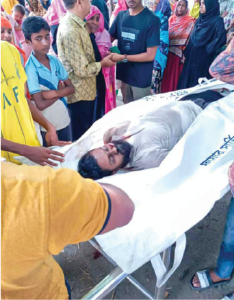
Abdullah Ibn Shahid took part in the Victory March on 5 August and reached Doratana. The murderous Hasina had already ordered the genocide. When fascist forces and killer police attacked the Jessore march, it scattered. Some protesters sought refuge at Zabar International in Doratana, where Abdullah Ibn Shahid also took shelter.
The brutal forces soon set fire to the building, and he was martyred in the ensuing blaze.
Economic Situation
Abdullah Ibn Shahid’s father is a farmer. His family has fallen into poverty due to the loss of their son.
At a Glance: Information Related to the Martyr
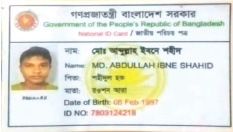
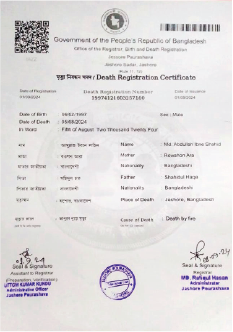
Name: Md. Abdullah Ibn-e-Shahid
Date of Birth: 06-02-1997
Father's Name: Shahidul Haque
Mother's Name: Rowshan Ara
Spouse: Mumtahina Jannatul
Child:
1. Rayyan (5), Nursery
Sibling: Sadman, Government City College, Jashore
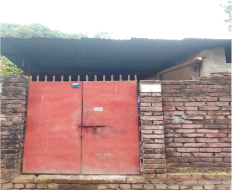
Permanent Address: Ghop, Noapara, Ward-03, Jashore
Present Address: Panchaikha, Bhulta, Rupganj, Narayanganj
Place of Incident: Doratana Jabir International, Jashore
Assailant: Arson attack by members of the Jubo League
Time of Injury: Approximately 4:00 PM, 05-08-2024
Nature of Injury: Burn injuries caused by fire
Date, Time, and Place of Death: 05-08-2024
Grave Location: Ghop Central Road, Jashore
Recommendations
1. Arrangements for both a monthly and a one-time financial allowance
2. Employment opportunity to be arranged for the martyr’s wife
Quranic Verse
And do not say of those who are killed in the way of Allah, "They are dead." Rather, they are alive, but you perceive it not. (Surah Al-Baqarah 2:154)
Hadith Sharif
The Messenger of Allah (SAW) said, "A martyr will be able to intercede for seventy relatives in Paradise." (Sunan Abu Dawood 2520)
👥 Shaheeds from the Same Division
Dhaka
Memorial Photo Gallery