📱 Smart QR Code
Scan to view & share this memorial biography directly.
🌹 Prayers
Click to send your sincere respect and prayers for this hero
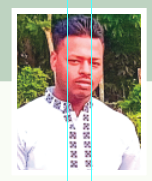
Md. Noyon
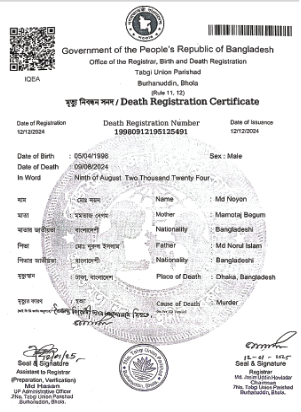
📅 Date of Birth
5 April, 1998
🕊️ Date of Martyrdom
9 August, 2024
🗺️ Division
Barishal
📍 District
Bhola
👤 Short Biography
Profession: Engaged in Fraudulent Activities
Place of Martyrdom: Supermax Healthcare Limited, Dhanmondi, Dhaka
Incident Details & Martyrdom Narrative
That History Is Not Written by Politicians Alone*
Profile of the Martyr
The name “Noyon†sounds like the ripple of calm water, yet in reality, he was the eternal roar of a storm. Born in the soil of Bhola, into a family soaked in labor and hardship. His father, Nurul Islam, still pedals a rickshaw through the sweating alleyways of Dhaka—unfazed by sun, rain, or the whistle of police. His mother, Momtaz Begum, a housewife whose world revolved around a sari's end, pots and pans, and a quiet pride for her son. Noyon held no official rank, no political title. His name appeared on no banners or bulletin boards. Still, history dragged him into its headlines. He was a garment worker—one of those men who toiled endlessly between New Market and Gausia, hopping from shop to shop in the narrow backlanes. A man for whom even a cup of tea required budgeting. And yet, he dreamed: "I’ll send my daughter to school one day." His wife, Arzu Begum, cherished a hope for a tiny home—where the kitchen would be separate and the window would welcome the breeze. Noyonused to think: "One day, even I’ll have an address in this city: Noyon, house number this, lane number that." That glow of hope shimmered in their home, though the means to reach it were meager—Noyon’s was the only earning hand. His two younger brothers, Hasnain and Mohsin, looked up to him the way parched earth awaits the first drop of rain. Noyon was that drop—an assurance that life could still be sustained. During the July Revolution, he wasn't in any procession. He wasn’t marching. But still—he was shot. He wasn’t holding a mic or standing on a stage. He was merely standing at a shop corner, looking for work. And in that search, a bullet found him—fired with the cold contempt of a state that seemed to say: “Your life holds no value.†But such contempt often boomerangs through history. Noyon, who never joined a rally, is today a flag painted in blood. No slogan lifted his body, but the earth gave him the dignity of a martyr’s grave. His death is not merely a passing. It is now a presence—seen in his wife’s silent tears, in the dusty schoolbag of his daughter, and in his father’s still-pedaling rickshaw. Noyon was the kind of Bengali nobody ever remembered. Today, his name is absent from the news and memorials. But the ink of Bangladesh’s uprising has turned crimson in his blood. He now lies quietly in his grave. And yet, his silence quickens our pulse. His story is not over. Because a nation that learns his name only after death—cannot forget him so easily. Noyon has become a question: “In this country, is standing still also a crime?â€
Background of the Movement
The days of July and August 2024 scorched the pages of Bangladesh's calendar with flames.
Once-deserted campuses, depressed canteens, and silent libraries melted into the streets—echoing with slogans and choked fury.
It began with a whisper: a protest demanding quota reform. But the silence of the regime and the bloodshot eyes of police turned that whisper into a fountain of blood. The despair of unemployed youth, electoral betrayal, abductions, arrests—everything shredded the nerves of the people. A generation that had seen the decay of dictatorship but not its end—rose to fight. Books were replaced with posters. Ink turned into tears. The air in Dhaka, now heavy with gunpowder and grief. Not all stood at the front lines. Many, like Noyon, were in the background—but present nonetheless. He stood near Durrani Bridge beside the new Lalbagh Police Station on the night of August 5, past midnight. There was panic around. Helicopters buzzed above. Flames flickered under flyovers. He gave no slogans. He set no cars ablaze. He just stood there—perhaps thinking,
“Let me see this with my own eyes. One day, I’ll tell my daughter—people once stood here for history.†But history had other plans. It reached out and etched itself into his chest with a bullet. On August 9, at 5:30 PM, in a private hospital in Dhanmondi— Noyon became a martyr. A young working-class man who had always stood for others—his shop owner, his family—stood, unknowingly, for the future of this country. But in the eyes of fascism, standing is a crime. And in this country, if you're in the wrong place at the wrong time—you’re shot in the chest. Noyon was no political cadre. There were no posters with his face. But his body bore the preamble of a movement for freedom. The state never knew him. Never touched him. But we did. We remember the night. The gunfire. The hospital’s silence. The movement did not birth Noyon. But his death gave it a name, a face, a bloody truth. Today, when we remember the July Revolution— Noyon’s standing becomes our standing: calm, steady, revolutionary.
The Tragic Death
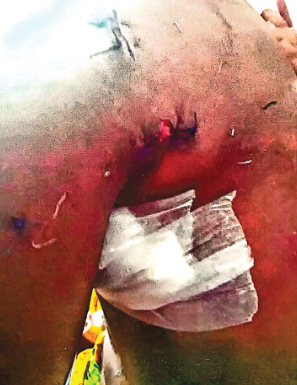
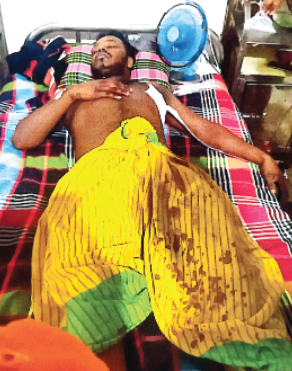
“I got the call around midnight,†said a trembling father's voice. A hidden number. A chilling question: “Is your son Noyon?†Then came the unthinkable: “He’s been shot—five times.†Tears didn’t come. Nor did speechless shock. Only a mad sprint into the night began—Nurul Islam, the father, the rickshaw puller, now racing toward death’s address. He found his son bleeding under Durrani Bridge. Familiar face. Unfamiliar stillness. Noyon’s eyes half-open. Body limp. Still alive—but the end was near. He carried him to an auto-rickshaw. Through the city’s cracked roads. The journey became a symbol of Bangladesh itself— A justice system whose gates are locked from the front while blood pours from the back. The first hospital refused him. He wasn’t yet dead. Still breathing. Still dangerous to a regime of fear. Eventually, doctors operated—removing two bullets, leaving others inside—silent testaments to a state’s cruelty. At his side stood brother Hasnain, witnessing each moment, each decline. Until one afternoon—death came silently to Noyon’s bed and said, “This is no longer your place.†The family’s final hope, the wheel that kept their lives turning—stopped forever. Today, Noyon’s mother hides her tears from her granddaughter. His wife braids their daughter Ayesha’s hair with a broken heart.
Ayesha does not understand yet. She only knows: “Abbu went away one day—and never came back.†At his grave, she asks: “Why won’t you wake up, Abbu?†There is no answer. Not from the state. Not from history. Even more cruelly, three months after his death, the state exhumed his grave— In the name of “investigation,†Stripping peace from even his afterlife.
Noyon was not a rioter. Not a provocateur. He was a garment worker. A husband. A father. And at last, a martyr. The bullet holes in his chest are now the hollow pride of this nation. The state may have said: “This land is not yours.†But his grave answers: “This land is mine too. I bought it with blood.†His death is no longer personal. It is the diagnostic tool for a sick system. Whenever we forget— ’s body rises again to ask: “Where were you that day?â€
Family Condition & Demands
’s death didn’t just silence a man. It silenced a whole rhythm of life. The sound of tea cups. The warmth of shared meals. The joy of sunlight on a balcony—gone. His father still pedals a rickshaw—from Azimpur to Banani—wondering, “I had a son. Now I only have silence.†His wife, Arzu Begum, no longer wears sindoor. Each day, she leaves home to look for domestic work. But society sees only her solitude—not her strength. The ones who should offer sympathy are lost in meetings. No party. No leader. No organization came to say: “We see your pain.†Why? Because ’s face was never on a poster. He didn’t shout slogans. Didn’t carry sticks. Yet he died. And that death reminds us— Sometimes, even standing still is a crime. His daughter Ayesha still waits. His brother Hasnain whispers: “We’re alive, but everything else has died.†This family does not beg for mercy. They ask for justice. They demand:
1. A permanent monthly allowance to ensure basic survival.
2. Full responsibility for Ayesha’s education by the state—she is a martyr’s heir.
3. Employment for Hasnain and other family members—not handouts, but dignity.
4. A permanent, secure home—because a house is not just walls, but security, honor, and hope.
never made a single demand while alive. But in death, he leaves behind a searing question: “Does the state only see those with flags behind them?†If we forget in silence— We bury not just him, But our own humanity. To stand with this family, Is to awaken what’s left of our human soul.
________________________________________
At a Glance: Martyr's Profile
Full Name: Md. Noyon
Date of Birth: April 5, 1998
Occupation: Embroidery worker
Father’s Name: Md. Nurul Islam (Age 61, Rickshaw Puller)
Mother’s Name: Momtaz Begum (Age 56, Housewife)
Wife: Arzu Begum
Daughter: Ayesha
Permanent Address: Village: Mulaipattan, Ward-09, P.O.: Munshirhat, Upazila: Borhanuddin, District: Bhola
Present Address: Kamrangirchar, Dhaka
Injury Location: Near Durrani Bridge, beside Lalbagh Police Station, Dhaka
Assailant: Police
Cause of Death: Gunshot wounds (homicide)
Time of Injury: August 5, 2024, around 12:00 AM
Date and Time of Death: August 9, 2024, 5:30 PM
Place of Death: Supermax Healthcare Ltd., Dhanmondi, Dhaka
Grave Location: Beside Hafiz Ibrahim College Mosque, Bhola
Quranic Verse
And do not say of those who are killed in the way of Allah, "They are dead." Rather, they are alive, but you perceive it not. (Surah Al-Baqarah 2:154)
Hadith Sharif
Abdullah ibn Masud (RA) reported: The Messenger of Allah (SAW) said, "The souls of the martyrs are in the bodies of green birds." (Sahih Muslim 1887)
👥 Shaheeds from the Same Division
Barishal
.jpeg)

Memorial Photo Gallery