📱 Smart QR Code
Scan to view & share this memorial biography directly.
🌹 Prayers
Click to send your sincere respect and prayers for this hero
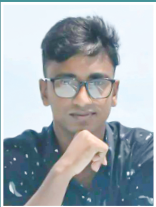
Sheikh Rakib
📅 Date of Birth
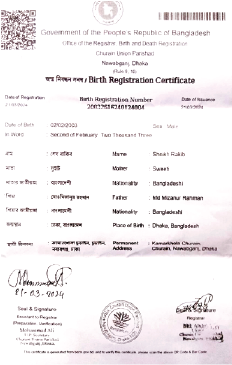
2 February, 2003
🕊️ Date of Martyrdom
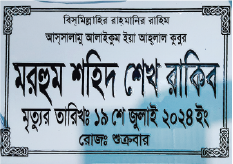
17 July, 2024
🗺️ Division
Dhaka
📍 District
Gazipur
👤 Short Biography
Profession: Welder
Place of Martyrdom: Beside Jamuna Future Park, Nadda, Dhaka
Incident Details & Martyrdom Narrative
Sheikh Rakib was born on February 2, 2003, in the village of Kamarkhola under Churain Police Station, Nawabganj District, Dhaka Division. He was the second child of Mizanur Rahman, also known as Humayun Kabir, and Sweety Akter.
In an effort to alleviate the burdens of poverty, his father migrated abroad. However, due to misfortune, he failed to remit any financial support back home. As the family's situation worsened, his mother moved to Gazipur in search of employment, leaving her children in the care of their grandmother. She began working as a garment’s worker. At that time, the eldest son, Sheikh Sakib, was only 12 years old. Unable to bear his mother's suffering, he stepped forward to shoulder the responsibility of the household at that young age.
Sheikh Rakib closely witnessed the struggles and sacrifices of his elder brother from an early age. He was deeply moved by this and always tried to ease his brother’s burden in any way he could. However, it became increasingly difficult for young Sakib to support the entire family alone while living in Gazipur. As a result, their mother and two younger sons were sent to live with their maternal grandfather, where Sheikh Rakib spent a portion of his childhood and adolescence.
After passing Grade 8, Rakib left his studies to support his family and moved to Gazipur to join his elder brother. Later, to prepare for traveling abroad with his father to Bahrain, he began working at a welding shop in front of Jamuna Future Park. He had planned to go abroad in 2024 after gaining experience in this trade.
Although he did not have the opportunity to pursue extensive formal education, Rakib harbored a deep love for learning. Having grown up in the shadow of harsh poverty, he developed a gentle heart and a quiet, humble disposition. Despite having the chance to escape hardship by joining his father in Bahrain, he could not remain silent during a time of national crisis. When the nation called, he took a stand alongside the student and civilian movement.
Description of the Incident
Since coming to power in 2009, the authoritarian Awami League government has sought to corrupt both national and international administrative structures, gradually implementing a blueprint to destroy internal order — including education, healthcare, and commerce — in an effort to create subservient individuals loyal to India. The extreme mismanagement became glaringly evident during the COVID-19 pandemic.
In earlier years, the leaking of examination questions, designing curricula that idolize Mujib, authoring textbooks prioritizing secular ideologies, and the deliberate disruption of academic environments by the student wing Chhatra League — all were executed under the directives of Prime Minister Sheikh Hasina. Hospitals became centers of corruption under the guise of requisitions and tenders, with large-scale embezzlement of funds. For example, a single curtain for the ICU of Faridpur Medical College was priced at 3.7 million BDT. Former Health Minister Mohammad Nasim and his son were accused of such corruption, undermining the healthcare system to the extent that citizens were forced to seek treatment abroad, particularly in India.
The authoritarian influence also extended deeply into law enforcement, with several high-ranking police officers openly supporting Hasina's regime. One such officer, SM Tanvir Arafat, the then Superintendent of Police (SP) of Kushtia, made a controversial speech offering opposition parties “three options.†He said:
1. "If you act unruly, your arms will be broken, and you’ll be imprisoned."
2. "Remain completely silent, and you are not to question the country’s independence or Bangabandhu’s history."
3. "If you don’t like Bangladesh, then you are welcome to go to your dear Pakistan."
This speech drew widespread criticism. In another rally, he stated he would “put people to sleep without a pillow,†a direct threat indicating extrajudicial killings. Under Hasina’s regime, enforced disappearances and killings through the police and RAB became commonplace. Thousands of anti-Awami League activists were arrested and permanently disappeared.
In 2024, the quota reform movement in Bangladesh re-emerged as a major issue. The 2024 movement can be seen as a new chapter of the 2018 student-led protest for reforming the public sector quota system, which had previously succeeded in reducing the quota from 56% to 30%. The 2024 movement gained momentum following a High Court verdict on June 5, which declared the circular abolishing the freedom fighter quota as illegal. This led to widespread protests and demonstrations across universities, particularly Dhaka University, where students demanded full abolition of the quota system and reinstatement of the 2018 reforms.
Between July 2 and 6, the movement spread to numerous campuses under the banner of “Anti-Discrimination Student Movement.†On July 4, the Appellate Division of the Supreme Court upheld the High Court's verdict, intensifying the protests. Demonstrators took to the streets on July 7 and 8, demanding a new law to eliminate all forms of unjust and discriminatory quotas. Although the government announced a four-week status quo on July 10 regarding the quota matter, the protesters continued their demonstrations due to the absence of concrete commitments.
By July 12, the protests escalated further as students blocked the Shahbagh intersection in Dhaka, demanding quota reforms and condemning police brutality against students outside Dhaka. Former Law Minister issued warnings to the protesters, suggesting the government would be forced to act if protests continued. However, the students ignored the warnings and intensified their demonstrations, heightening political and social tensions.
The students’ demand became singular and resolute — complete reform of the quota system, with the formulation of a new law to abolish all forms of unjust and discriminatory quotas. On July 13, students in Rajshahi blocked railways in protest. Dhaka University students held a press conference on the same day, alleging that legal cases were being filed to obstruct the movement. Protesters insisted on a fair and logical reform of the quota system.
On July 14, students organized a mass rally across all grades and submitted a memorandum to the President. However, that evening, then-Prime Minister Sheikh Hasina made a controversial remark referring to the protesters as “Razakars†(a derogatory term referring to collaborators during the 1971 war), which sparked nationwide outrage. That night, protests intensified with slogans such as, “Who are you? Who am I? Razakar! Razakar!†and “Who said it? Who said it? Autocrat! Autocrat!â€
On July 15, members of Chhatra League attacked the protesting students with weapons, triggering massive clashes. Police, RAB, BGB, and the ruling party’s student, youth, and volunteer wings engaged in brutal violence against the demonstrators. In the following days, the situation worsened, with protesters demanding the Prime Minister’s resignation and an end to the oppression of the Awami League government.
On July 17, a coordinated crackdown began in Dhaka. Armed government forces, including police, BGB, and Awami League operatives, launched assaults on unarmed protesters using firearms from helicopters. Similar incidents occurred across the country, including in front of Jamuna Future Park in Dhaka.
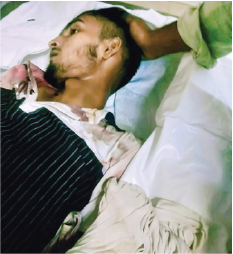
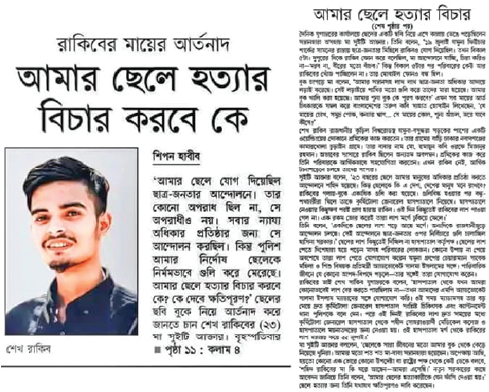
Rakib, a bystander who witnessed the brutality from his workplace near Jamuna Future Park, could not bear the oppression and joined the protesters. He was shot by police. His friends rescued him and took him to Kurmitola Hospital. Rakib’s brother, upon hearing the news, rushed from home and sought help from locals to reach the hospital. A doctor and an ambulance driver from Modern Hospital assisted him in transporting Rakib from one end of Dhaka to the other. During the journey, they witnessed further barbarity as the police fired on their ambulance. Rakib was admitted to the hospital by noon, and Shakib, his brother, arrived shortly afterward — only to find that Rakib had already died.
Rakib’s friends waited outside the morgue, but hospital authorities initially denied Rakib’s presence. Later, it was revealed that his body had indeed been kept in the morgue. Shakib, who worked as a driver for a residence near Jamuna Future Park, called Mrs. Babul, the wife of the owner of Jamuna Group, and informed her of the situation. The army intervened, compelling hospital authorities to admit that they were storing the bodies of two deceased protesters.
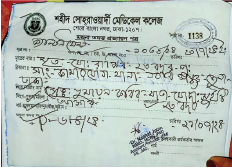
After three days of moving between facilities, Shakib finally received Rakib’s body from the Shaheed Suhrawardy Medical College morgue on Monday.
Quranic Verse
Indeed, Allah has purchased from the believers their lives and their properties for [that] they will have Paradise. They fight in the cause of Allah. (Surah At-Tawbah 9:111)
Hadith Sharif
Abu Huraira (RA) reported: The Messenger of Allah (SAW) said, "Whoever sincerely asks Allah for martyrdom, Allah will grant him the status of martyrs." (Sahih Muslim 1888)
👥 Shaheeds from the Same Division
Dhaka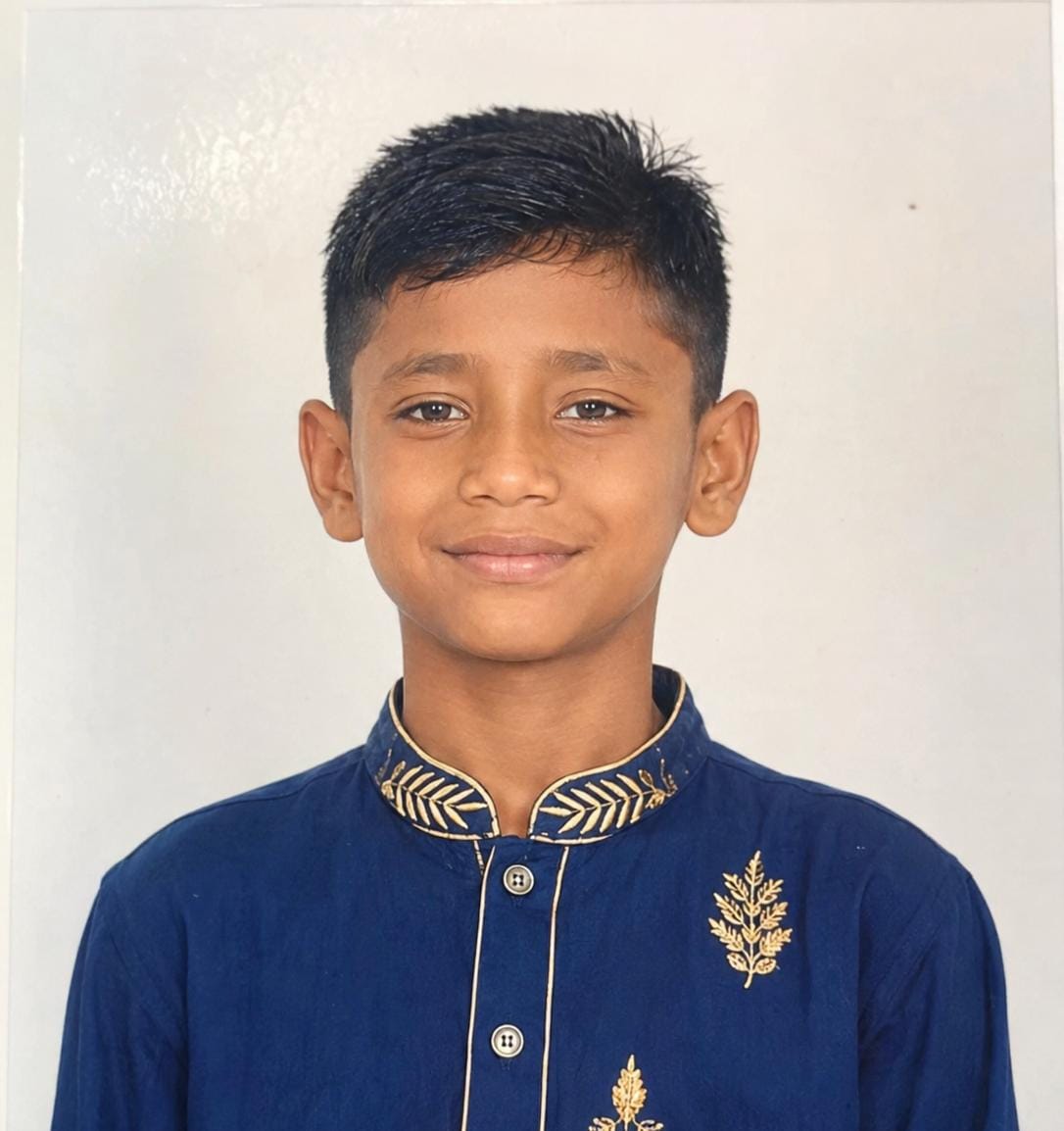
Memorial Photo Gallery