📱 Smart QR Code
Scan to view & share this memorial biography directly.
🌹 Prayers
Click to send your sincere respect and prayers for this hero
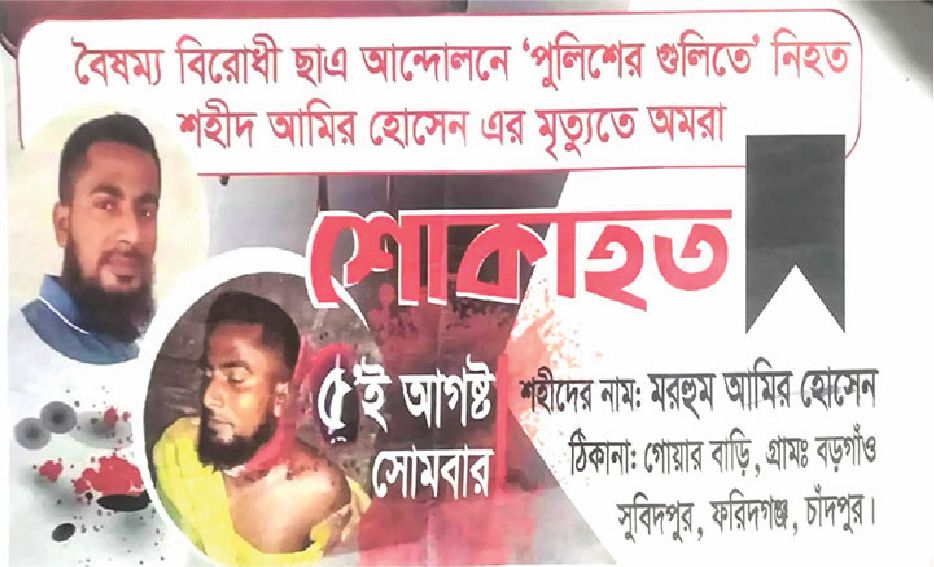
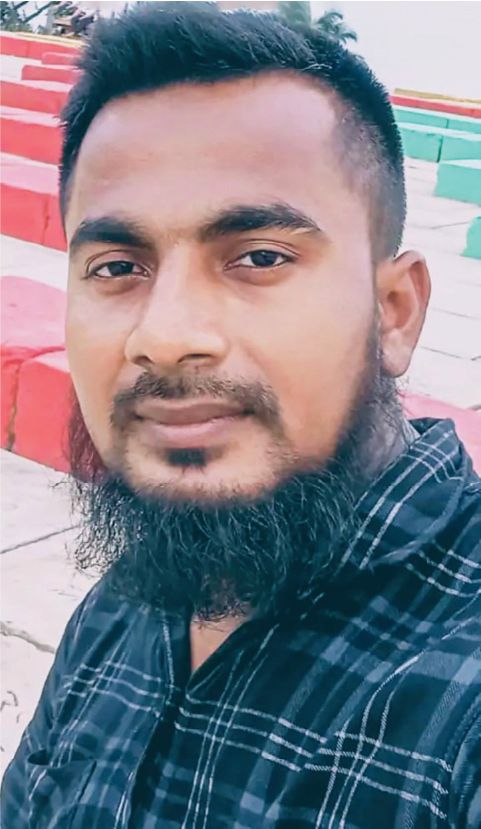
Amir Hossain
📅 Date of Birth
7 May, 1992
🕊️ Date of Martyrdom
5 August, 2024
🗺️ Division
Chattogram
📍 District
Chandpur
👤 Short Biography
Profession: Private Car Driver
Place of Death: Uttara, near Airport, Dhaka
Incident Details & Martyrdom Narrative
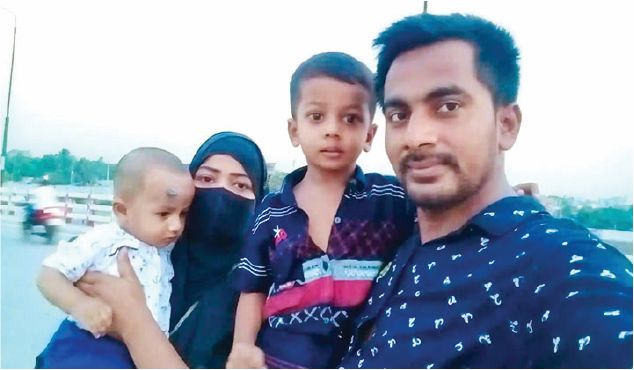
His father, Khorshed Alam, was a farmer who earned a living by tilling the soil, while his mother, Rahima Begum, prepared meals on a hot stove with a faint smile and tired eyes. His wife, Yasmin Begum, was the queen of their humble home, reigning over the clay stove in the kitchen, while her husband was a soldier in the life’s battlefield of the streets. Their eldest son, Yasin, was only five years old—eyes full of infinite wonder—and the younger, Ibrahim, barely two and a half, still unaware how to call his father but knowing how to touch his photo and cry. Their family now survives on charity, where the word “dream†is forbidden, and a school uniform lies as a luxury gathering dust on the highest shelf of the cupboard.
Amir was never a member of any political party. Except on election day, he never attended any rally. His only party was his family; his only gathering was sitting in the evening on the veranda with his wife and children, sipping tea. Yet, in August 2024, when the roar of bullets filled the streets of Dhaka under a fascist government, Amir removed his hands from the steering wheel and stepped out—shoulder to shoulder with ordinary people. He didn’t register with any group or banner, standing only under the banner of conscience. That stand became his death sentence. When he was shot on the street, the only question in his eyes was: “I have done no wrong, so why?†That question still lingers in the air, unanswered by the state, government, or administration, all hiding behind a mask of silence.
Amir Hossain was not a leader hanging on posters, nor a speaker favored by public rallies or video messages. He was one of millions of ordinary people who drive vehicles daily, pay their bills, run their households—whose voices of protest, long held back, exploded one day. Today, his family lives in a modest home, burdened by an unknown grievance. His children still do not know how their father gave his life for this country. But we must know, because Amir’s death is a declaration: The future of this country will not be written solely by political handshakes, but by the hands that once left the steering wheel to answer the call of freedom.
Background of the Movement
From July to August 2024, Bangladesh entered a new crucible of liberation. The enemy was not foreign troops but a demonic ruling system within the state—a government that, under the name of Sheikh Hasina, held three one-sided elections, none with true public participation or consent, marking the epic of extreme tyranny. People could no longer remain silent. From university classrooms to laborers’ wristwatches, a message spread across cities and villages, from tea stalls to mosque minarets: “Enough inequality.â€
On August 5, a fateful date, whispers spread through Dhaka: "The dictator has fled." Some said abroad; others spoke of secret military hideouts. But the people’s voice was unified: Victory. The streets flooded with ordinary people, without political banners, only filled with grievances and dreams. Among them was Amir Hossain—a driver, an ordinary father who had never before touched political fire. Yet that day, his sense of justice led him to the streets, where no force pushed him; his conscience did.
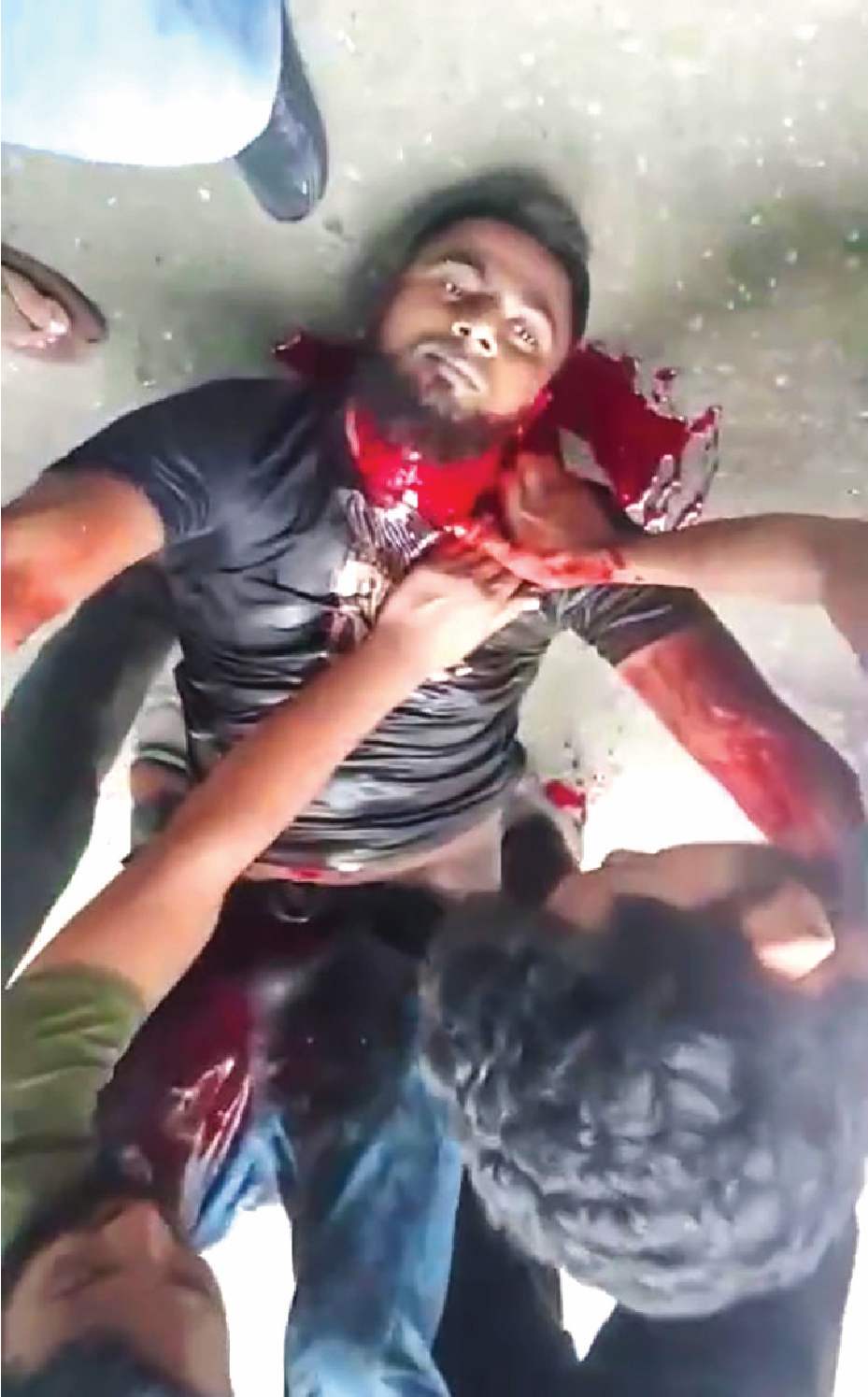
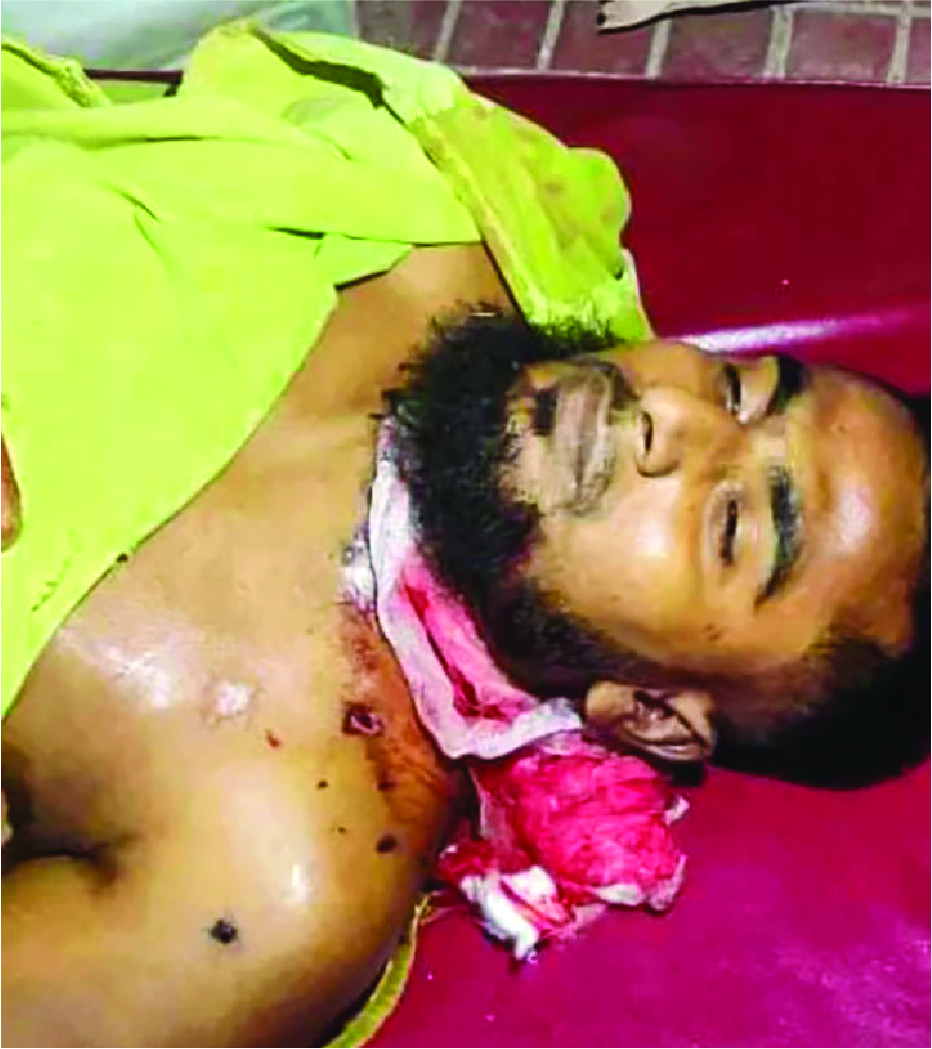
The airport area became a sea of people chanting “We want democracy, we want justice.†Then the sky seemed to tear open as the true face of the state appeared. Law enforcement, sworn to protect, opened fire indiscriminately. No warnings, no explanations—only the roar of guns and flying bullets. Amidst the chaos, Amir stood still. He carried no weapons, shouted no slogans, but his deep gaze seemed to say, “What kind of country will I leave for my children?†Two bullets struck his neck, another ripped through his chest and back. Blood spilled onto the ground, washing away dreams of his youngest son’s school bag, money saved to buy a new saree for his wife, or medicine for his ailing mother.
He died on the street, never reaching a hospital. Yet at death, his face showed no fear—only an immense peace that comes when one is ready to die for the truth. Amir Hossain’s death was not merely the result of bullets, but the silent uprising of an ordinary citizen against state injustice. He bore no flag, yet his body became a new banner, silently flying over the soil of millions of deprived hearts.
The Martyrdom and the Silence After
After the gunfire ended, a chilling silence followed—so deep that people forgot if they were still alive. In this eerie silence lay the lifeless body of Amir Hossain on Dhaka’s airport road—not just a corpse but an invisible draft of history. Two bullet wounds in the neck, torn skin over his chest from pellets, blood-soaked clothes: this still spoke, “I am not dying; I live on through my blood.†People fled, some took pictures, others ran away. To law enforcement, he was just an ‘injured in conflict’; to the state, an ‘unknown dead.’ On the way to the hospital, in an ambulance with open doors and heavy air smelling of gunpowder, Amir’s heartbeat ceased—quietly, as he had lived: not loudly, but through action.
What followed was a second chapter of murder. His wife Yasmin called repeatedly from the afternoon, getting no connection. At 11 PM, a local youth brought the news, choking out, “Your husband has been shot...†Yasmin could hardly grasp the weight of the words. No official contact, no media coverage, no government statement—like it never happened. When his body arrived at his ancestral village, little Ibrahim held a broken toy car like his father’s car, with its head bowed. Five-year-old Yasin stood silently behind the door, sensing something was wrong but unable to understand that the man he knew would never return.
The state busied itself pretending ‘security is restored.’ No officials came, no martyr recognition announced. Yet Amir stood on the street, head held high amid gunfire, for truth alone. His death was denied by the state but accepted by history. When he was buried in Faridganj, Chandpur, the sky was dark, the air silent, filled only with women’s cries and children’s whispers. No one declared him a martyr, but the word spread: “Amir did not die from bullets; he fell protecting the face of history.â€
Thus, silently, the state kills a future—not only by shooting but by forgetting and denial. Yet one day, someone will paint those bullet marks on walls, and children will recognize him by name, not from books but from the story written in blood. Then it will be said: Amir Hossain did not merely drive a car—he drove a revolution, until his last breath.
Amir Hossain no longer drives cars; he now drives the wheels of the nation with his blood. If we forget Martyr Amir Hossain, we lose not just a man—we lose a revolution.
Quick Facts about Martyr Amir Hossain
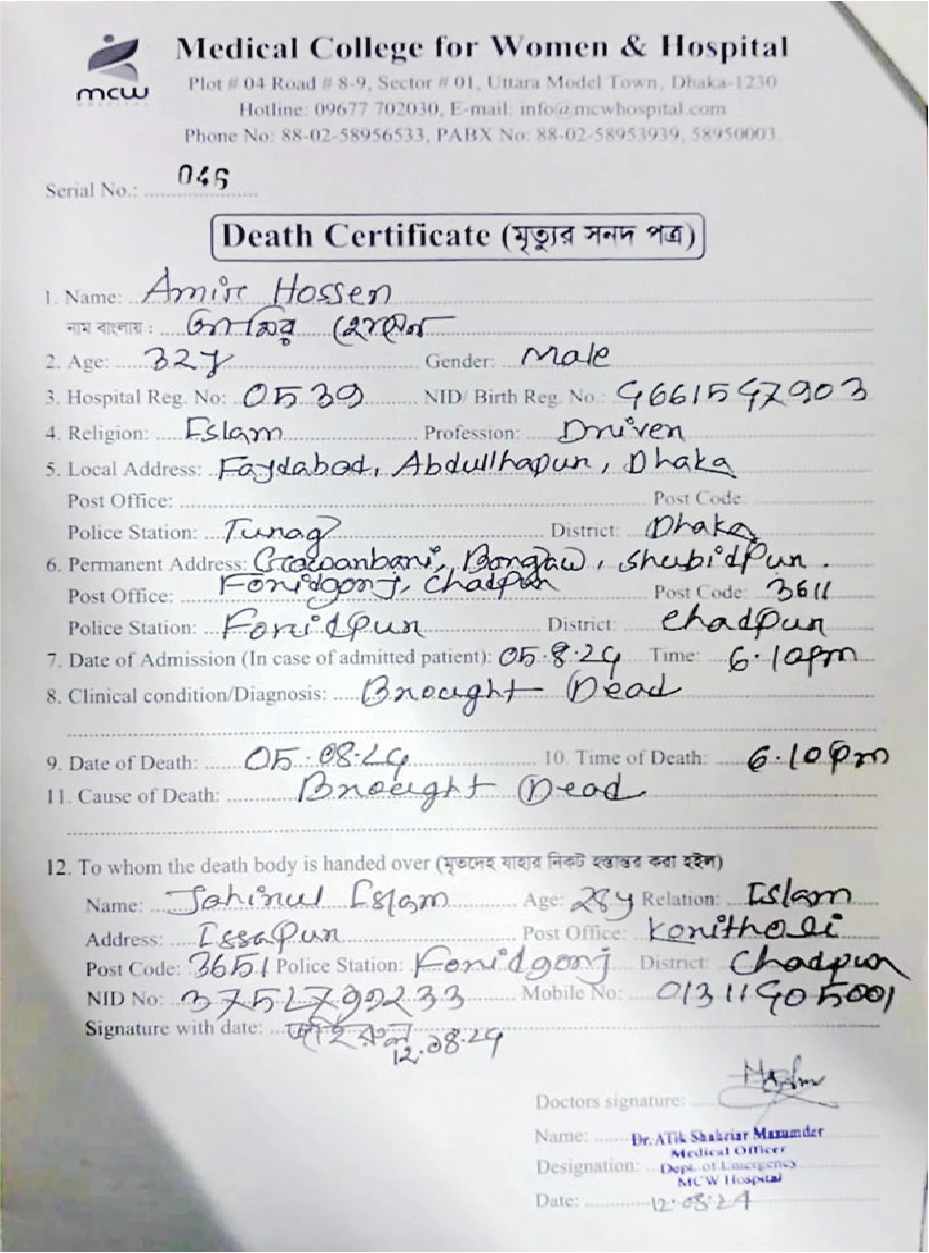
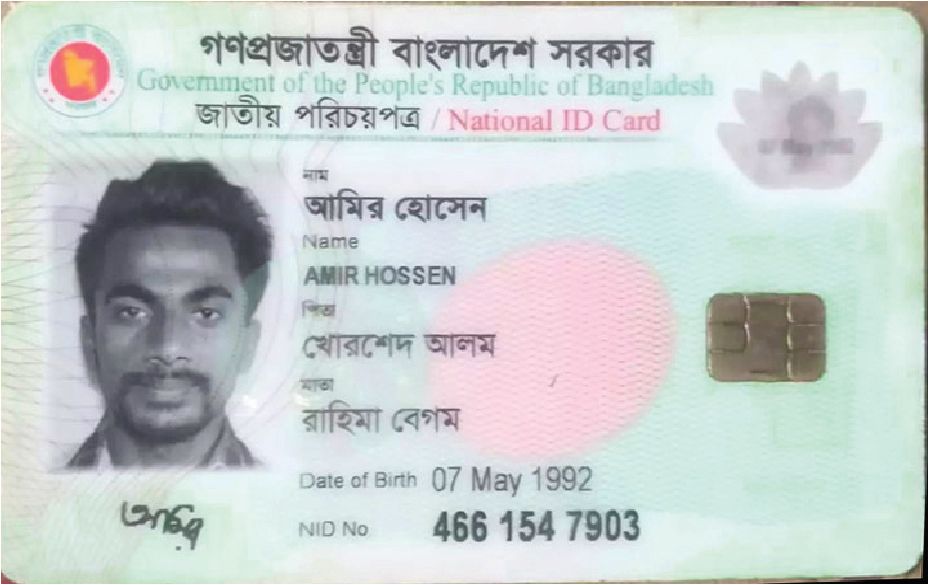
Name Amir Hossain
Date of Birth May 7, 1992
Profession Private Car Driver
Address Borgao, Subidpur, Faridganj, Chandpur
Father Khorshed Alam (55, Farmer)
Mother Rahima Begum (50, Housewife)
Wife Yasmin Begum (30, Housewife)
Children Yasin (5 years), Ibrahim (2.5 years)
Incident Date & Place August 5, 2024, Dhaka Airport Area
Time of Injury Approx. 4 PM
Injuries Two gunshots to the neck, pellet wounds in chest
Outcome Died en route to hospital
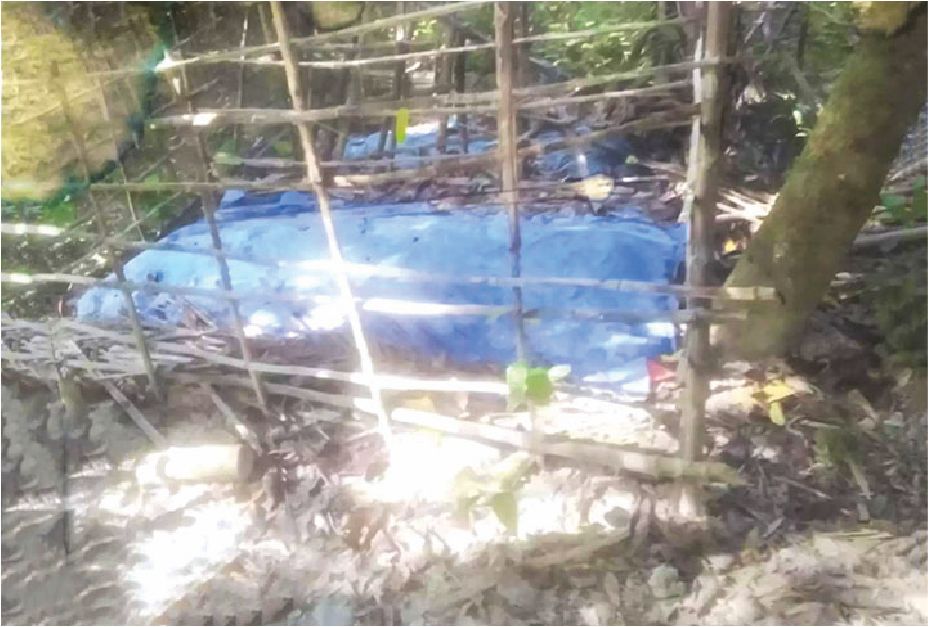
Burial Family graveyard in native village
Current Status of Family Surviving on financial aid
Recommendations
1. Full educational sponsorship for both sons.
2. Support for wife Yasmin Begum to start a handicraft or small business.
3. Government assistance to build a house on family land.
Quranic Verse
And do not say of those who are killed in the way of Allah, "They are dead." Rather, they are alive, but you perceive it not. (Surah Al-Baqarah 2:154)
Hadith Sharif
The Messenger of Allah (SAW) said, "A martyr will be able to intercede for seventy relatives in Paradise." (Sunan Abu Dawood 2520)
👥 Shaheeds from the Same Division
Chattogram.jpeg)

Memorial Photo Gallery